

Jump to section
Pay Periods Without the Math.
Set your pay period once in OnTheClock, and every timecard adds up automatically when the period ends.
Try It Free!Key Takeaways: Understanding Pay Periods
- ✔A pay period is the recurring span of time used to track an employee’s hours and earnings for one paycheck.
- ✔Weekly, biweekly, semimonthly and monthly schedules typically have 52, 26, 24 and 12 pay periods per year, respectively.
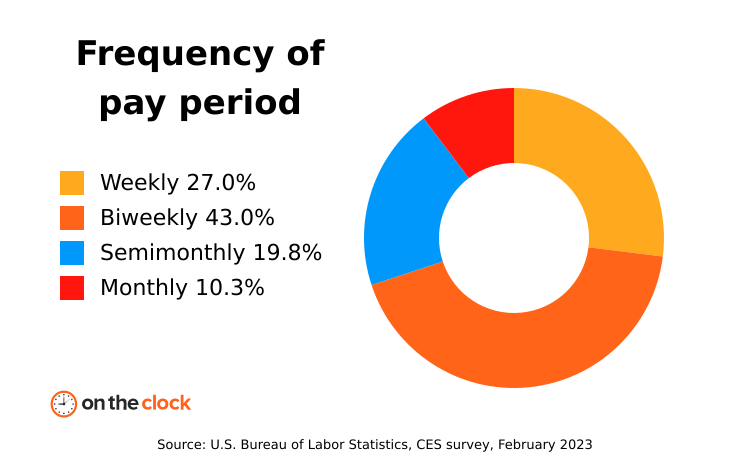
- ✔Biweekly pay is the most common schedule, used by 43.0% of private establishments in BLS’s February 2023 survey.
- ✔Weekly and biweekly schedules simplify overtime tracking because their pay periods cover whole workweeks.
- ✔Choosing a pay schedule depends on employee needs, state payday requirements, cash flow and payroll processing costs.
What Is a Pay Period?
A pay period is the recurring span of time, such as Monday through Sunday, during which an employee's hours and earnings are tracked for a single paycheck. When one pay period ends, the next begins, and employees are paid on a set pay date a few days later.
How a pay period works:
- The pay period starts. Hours begin counting on a set day, such as Monday.
- The pay period ends. Hours stop counting for that paycheck on a set day, such as Sunday two weeks later.
- Payroll is processed. Managers approve time sheets, and payroll calculates gross pay, taxes and deductions.
- Employees are paid. Pay arrives on the pay date, usually a few days after the period ends.
To figure out your own pay period, find the start and end dates your employer uses. Every hour you work between those dates shows up on the same paycheck.
Make Payroll Simple and Easy
Save time, reduce errors and make sure everyone gets paid on time.
Pay Period vs. Pay Date vs. Pay Frequency
These three terms get mixed up, but each means something different. One pay period equals one paycheck, not one month.
| Term | What it means | Example |
|---|---|---|
| Pay period | The span of time when hours and earnings are tracked for one paycheck | Mon., Sept. 14, to Sun., Sept. 27, 2026 |
| Pay date | The day employees receive pay for that period | Fri., Oct. 2, 2026 |
| Pay frequency | How often pay periods repeat | Biweekly (every two weeks) |
Pay Period Types
Most U.S. employers use one of four pay schedules: weekly, biweekly, semimonthly or monthly. Here's how they compare:
| Type | Paid | Pay periods per year | Length | Full-time hours per period |
|---|---|---|---|---|
| Weekly | Every week | 52 (sometimes 53) | 7 days | 40 |
| Biweekly | Every other week | 26 (sometimes 27) | 14 days | 80 |
| Semimonthly | Twice a month | 24 | 13 to 16 days | About 86.67 |
| Monthly | Once a month | 12 | 28 to 31 days | About 173.33 |
Full-time hours are based on a 40-hour week (2,080 hours a year).
Weekly Pay Periods
A weekly pay period covers seven days, often Monday through Sunday, with payday a few days after it closes. According to the Bureau of Labor Statistics (BLS), 27.0% of private establishments paid weekly as of February 2023. It's especially common in construction, hospitality and other industries with hourly workers.
Most years have 52 weekly paydays. A year gets a 53rd when your payday weekday occurs 53 times. A regular year has 53 of one weekday, the one Jan. 1 falls on. A leap year has 53 of two: the Jan. 1 weekday and the day after it. In 2026, Jan. 1 fell on a Thursday, so 2026 has 53 Thursdays. But Jan. 1 is also a bank holiday, and moving a payday off the holiday can shift which year gets the extra check.
Advantages:
- Employees get paid often, which helps hourly workers budget.
- Overtime is simple, because each pay period is exactly one workweek.
- Mistakes get caught and fixed within days.
Disadvantages:
- Running 52 payrolls a year costs more in processing time and fees.
- Managers have to approve time sheets every week.
- More payroll runs can mean more tax deposits for semiweekly depositors and more accrual entries.
Biweekly Pay Periods
A biweekly pay period covers 14 days, and employees are paid every other week on the same weekday, usually Friday. It's the most common schedule: 43.0% of private establishments paid biweekly as of February 2023, according to BLS.
Because each pay period covers exactly two workweeks, biweekly payroll lines up with how the Fair Labor Standards Act calculates overtime. That keeps overtime simple.
26 or 27 paydays: Most years have 26 biweekly paydays. About once every 11 years, a schedule's first payday lands so early in January that a 27th fits before Dec. 31. In 2026, that happens on two schedules: Thursday payers whose first payday was Jan. 1, 2026, if they paid it after the holiday instead of on Dec. 31, 2025, and Friday payers who move their Jan. 1, 2027, payday up to Dec. 31, 2026. See how to handle a 27th payday.
Three-paycheck months: Biweekly employees get two paychecks most months, and three paychecks twice a year in most years (three times in a 27-payday year). On a schedule whose first 2026 payday was Friday, Jan. 2, the three-paycheck months are January and July. If the first payday was Friday, Jan. 9, they're May and October.
Advantages:
- It's the most familiar schedule for employees.
- Overtime is easy to calculate, since each period is two full workweeks.
- Fewer payroll runs than weekly, with a bit more time to review timecards.
Disadvantages:
- Paychecks don't line up with monthly bills like rent.
- Three-paycheck months and the occasional 27th payday complicate budgeting and benefit deductions.
- It costs more to run than semimonthly or monthly payroll.
Semimonthly Pay Periods
A semimonthly pay period runs twice a month, usually from the 1st to the 15th and from the 16th to the last day of the month. That's 24 pay periods a year. 19.8% of private establishments paid semimonthly as of February 2023, per BLS.
Semimonthly periods don't line up with workweeks, so a single workweek can be split across two pay periods. Overtime still has to be calculated by workweek, not by pay period, which makes it harder to track for hourly, nonexempt employees.
Advantages:
- Paydays fall on the same dates each month, which makes budgeting easier.
- Each pay period stays within one month, so month-end accounting is simpler.
- Salaried employees get the same amount every paycheck.
Disadvantages:
- Overtime is harder to calculate, because workweeks cross pay periods.
- Paydays land on different weekdays, and sometimes on weekends or holidays.
- Pay periods vary in length (13 to 16 days), which can confuse hourly employees.
Monthly Pay Periods
A monthly pay period covers a full calendar month, with 12 paydays a year. It's the least common of the four: 10.3% of private establishments paid monthly as of February 2023, per BLS.
Monthly pay isn't an option everywhere. Rhode Island and Vermont don't allow it for most workers, Massachusetts doesn't allow it for hourly employees, and Connecticut and New Hampshire allow it only with state approval. See how pay periods are determined below.
Advantages:
- Payroll processing costs are lowest, with only 12 runs a year.
- Accounting is simple: one payroll lines up with one month.
- It works well for salaried employees.
Disadvantages:
- Employees wait up to a month for pay, which is hard on hourly workers.
- It isn't allowed for nonexempt employees in some states.
- Overtime from several workweeks has to be tracked and paid in one cycle.
Other Pay Periods
- Daily or on-demand pay: Some employers pay at the end of each shift, or let employees access earned wages before payday through an earned wage access app. It's common with day laborers and some hourly roles.
- Quarterly or annual pay: These are rare for regular wages, and state payday laws generally don't allow them for hourly employees. They're more common for bonuses, commissions or board stipends.
- Off-cycle payroll: An off-cycle run pays outside the regular schedule, such as a final paycheck, a bonus or a correction for a payroll error.
How Are Pay Periods Determined?
Employers choose their pay schedule, within limits set by federal and state law.
Federal law sets the baseline, not the schedule. The Fair Labor Standards Act doesn't require a specific pay frequency. It does require that wages be paid on the regular payday for the pay period covered, and that overtime earned in a workweek be paid on the regular payday for the period in which that workweek ends.
State payday laws set the minimums. Most states set how often employees must be paid, and many also set how soon after a pay period ends wages are due. Some require weekly or biweekly pay for certain workers, and several don't allow monthly pay for nonexempt employees. Check your state in the Department of Labor's state payday requirements table.
You pick the dates. Once you've chosen a frequency, set a start day, an end day and a pay date. Leave enough time between the end of the pay period and payday for managers to approve time sheets, payroll to run and direct deposits to clear. For many employers, that's three to six days. See how to set up pay periods to work with pay dates.
Different groups can have different pay periods. A common setup is semimonthly for salaried employees and biweekly or weekly for hourly staff. Each schedule still has to meet your state's rules for that group.
Changing your pay period: You can switch schedules, but plan the transition so no one goes longer between paychecks than state law allows. Give employees advance notice, too. Some states require written notice before a payday change.
How Many Pay Periods Are in 2026?
In 2026, most employers have 52 weekly, 26 biweekly, 24 semimonthly or 12 monthly pay periods. A few weekly and biweekly schedules get an extra one.
| Pay frequency | 2026 pay periods | Who gets an extra payday in 2026 |
|---|---|---|
| Weekly | 52 or 53 | Friday payers who move their Jan. 1, 2027, payday up to Dec. 31, 2026, and Thursday payers who paid their Jan. 1, 2026, payday after the holiday |
| Biweekly | 26 or 27 | The same groups, if their schedule has a payday on Jan. 1, 2026, or Jan. 1, 2027 |
| Semimonthly | 24 | Never changes |
| Monthly | 12 | Never changes |
For ways to handle an extra payday, see how a leap year affects payroll.
Example: Q1 2026 biweekly schedule
This schedule runs Monday through Sunday and pays the following Friday. It's the same schedule as the Sept. 14 example above, and its three-paycheck months are May and October.
| Pay period start | Pay period end | Pay date |
|---|---|---|
| Mon., Dec. 22, 2025 | Sun., Jan. 4 | Fri., Jan. 9 |
| Mon., Jan. 5 | Sun., Jan. 18 | Fri., Jan. 23 |
| Mon., Jan. 19 | Sun., Feb. 1 | Fri., Feb. 6 |
| Mon., Feb. 2 | Sun., Feb. 15 | Fri., Feb. 20 |
| Mon., Feb. 16 | Sun., March 1 | Fri., March 6 |
| Mon., March 2 | Sun., March 15 | Fri., March 20 |
| Mon., March 16 | Sun., March 29 | Fri., April 3 |
What Type of Pay Period Is Right for You?
There's no single best pay period. The right one depends on your team, your state and your cash flow. Work through these questions:
- Are your employees hourly or salaried? Hourly employees usually do best with weekly or biweekly pay, because each period covers whole workweeks. Salaried employees fit any schedule, and semimonthly pay keeps their checks identical.
- How often do employees work overtime? If overtime is common, weekly or biweekly pay keeps it simple. With semimonthly or monthly pay, overtime still has to be calculated by workweek, even when a workweek spans two pay periods.
- What does your state require? Check minimum pay frequency and payday deadlines before you pick a schedule. Some states rule out monthly pay for nonexempt employees.
- How is your cash flow? Weekly pay means smaller, more frequent withdrawals. Monthly pay means one larger withdrawal. Biweekly pay adds two three-paycheck months each year.
- What will it cost to run? Every payroll run takes time, and some providers charge per run. Weekly is the most expensive schedule, and monthly is the least.
- What do your employees expect? Biweekly is the most common schedule (43.0% of private establishments, per BLS), so it's what most new hires are used to.
Quick recommendations:
- Weekly: Hourly teams with frequent overtime or variable schedules, such as construction, restaurants and seasonal work.
- Biweekly: Most small businesses, and especially mixed teams of hourly and salaried employees.
- Semimonthly: Mostly salaried teams, or businesses that want payroll to line up with the calendar month.
- Monthly: Salaried-only teams in states that allow it.
If you're unsure, talk with your accountant or payroll provider before you commit. Switching schedules later takes careful planning.
How to Set Your Pay Period in OnTheClock
OnTheClock tracks hours by the pay period you choose, so time sheets, overtime and reports line up with each paycheck. Once your pay period is set, approved hours can go straight to payroll.
- Log in to OnTheClock as an administrator.
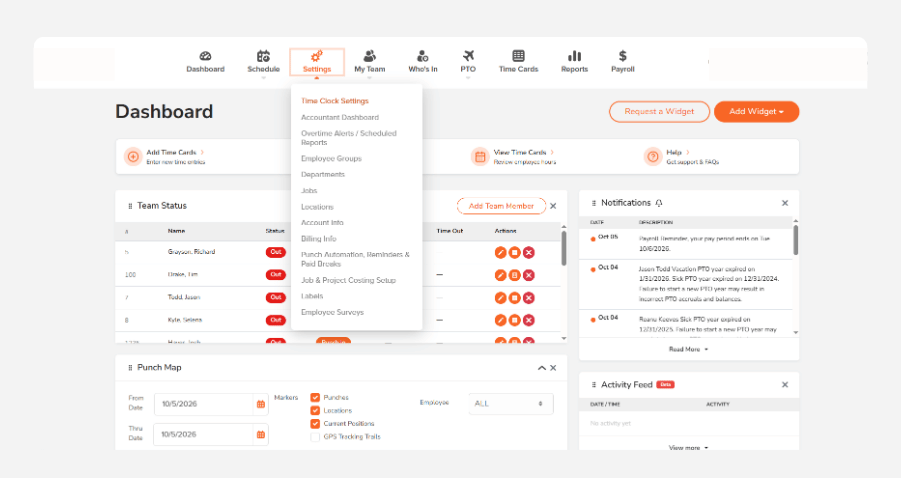
- Go to Settings, then Time Clock Settings.
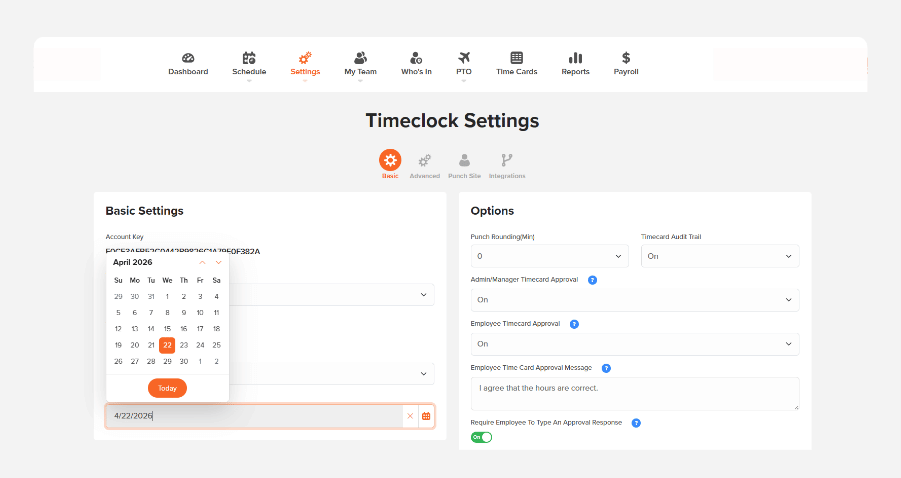
- Under Basic Settings, choose your pay period type: weekly, biweekly, semimonthly or monthly.
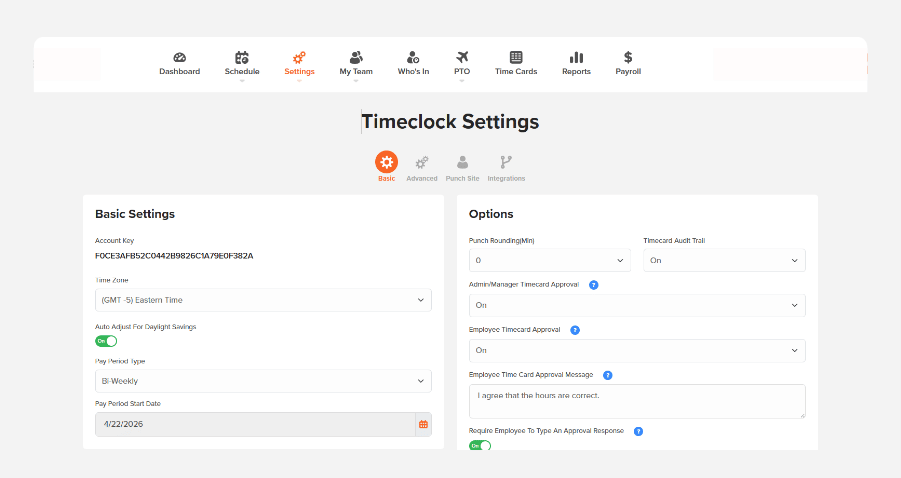
- Enter the date your pay periods begin in the Pay Period Start Date field.
- Click Save.
For help matching pay periods to pay dates, see how to set up pay periods to work with pay dates.
What Is a Pay Period: Frequently Asked Questions
How do you calculate your pay period?
Find the start and end dates your employer uses. Every hour worked between those dates is included in one paycheck. To estimate gross pay, add up the hours you worked in the period and multiply by your hourly rate, plus overtime at 1.5 times your rate for hours over 40 in any workweek.
How many pay periods are in a year?
Weekly payroll has 52 pay periods, biweekly has 26, semimonthly has 24, and monthly has 12. Weekly and biweekly schedules occasionally get a 53rd or 27th payday, depending on which weekday payday falls on and how the Jan. 1 holiday is handled. A leap year has two weekdays that occur 53 times instead of one.
How long after a pay period ends do you get paid?
Usually a few days to a week, depending on your employer's schedule. That gap gives managers time to approve time sheets and run payroll. Many states set a legal deadline for paying wages after a pay period closes, so check your state's payday requirements.
What happens if payday falls on a weekend or holiday?
Many employers pay on the last business day before a weekend or holiday. Banks don't process direct deposits on weekends or federal bank holidays, so a Saturday payday usually moves to Friday. Federal law doesn't set a rule for this, but some states do, so check your state's payday requirements.
Why is my pay period three weeks?
Regular three-week pay periods are rare. What usually looks like one is a three-paycheck month on a biweekly schedule, which happens twice in most years. It can also be a first paycheck that covers extra days because you started after a pay period's cutoff. Check your pay stub for the period start and end dates.
What happens if an employee starts in the middle of a pay period?
An employee who starts in the middle of a pay period is paid only for time worked. Hourly employees earn pay for every hour from their first shift. Salaried employees get prorated salary for the days worked, which federal law allows in the first week of employment. With OnTheClock, hours tracked from the first clock-in carry into payroll.
This article is for general information only and is not legal or tax advice. Payday laws vary by state and change often, so check with your state labor department or an employment attorney before changing your pay schedule.